Green Growth?

This post is adapted from an issue of The Weekly Letter, a newsletter I wrote during most of 2022. The newsletter is not currently accessible online, although I aim to archive it on this blog at some point.

Is it possible to address the environmental crises we face while continuing to pursue economic growth? I draw on several pieces referenced by Spencer Bokat-Lindell in his excellent article for The New York Times reviewing the green growth vs. degrowth debate as well as some other sources.

Economic growth—as measured by the indicator Gross Domestic Product (GDP)— has led to exceptional material prosperity, remarkable technologies, and great advancements in health. To take one example, in a Vox article, Kelsey Piper notes that there is a strong correlation between low child mortality and high GDP per capita. But the effects of the growth-focused economic system are not all positive. The growth model has steamrolled alternative economic, and often political, systems, reshaping the whole world in the image of the Global North. There is massive economic inequality, both within and between countries, and many people are unable to meet their basic needs. And most relevant to the question of whether growth can be environmentally sustainable, the growth-focused model has led to environmental crises, including climate change and biodiversity loss, which threaten the planet’s life support systems.

The prevailing approach to addressing environmental crises is known as green growth. Proponents of green growth argue that it is possible to continue growing GDP while also reducing material and energy use and quickly reaching net zero carbon emissions. However, some environmentalists have championed an alternative approach known as degrowth. In a journal article, degrowth proponent Jason Hickel writes, “Degrowth is a planned reduction of aggregate resource and energy use in high-income nations designed to bring the economy back into balance with the living world in a safe, just and equitable way.” Indeed, advocates argue that degrowth is necessary to bring the economy and the planet into balance. Hickel and Giorgos Kallis write in a review of empirical studies of green growth:

“extant empirical evidence does not support the theory of green growth. This is clear in two key registers. (1) Green growth requires that we achieve permanent absolute decoupling of resource use from GDP. Empirical projections show no absolute decoupling at a global scale, even under highly optimistic conditions. While some models show that absolute decoupling may be achieved in high-income nations under highly optimistic conditions, they indicate that it is not possible to sustain this trajectory in the long term. (2) Green growth also requires that we achieve permanent absolute decoupling of carbon emissions from GDP, and at a rate rapid enough to prevent us from exceeding the carbon budget for 1.5°C or 2°C. While absolute decoupling is possible at both national and global scales (and indeed has already been achieved in some regions), and while it is technically possible to decouple in line with the carbon budget for 1.5°C or 2°C, empirical projections show that this is unlikely to be achieved, even under highly optimistic conditions.”

In other words, Hickel and Kallis argue that evidence shows that a growing economy will, first, use more natural resources than is sustainable and, second, likely fail to make the transition away from carbon emissions quickly enough to meet the Paris Agreement targets. For these authors, green growth is an illusion.

(On climate change, a key issue is whether it is appropriate to employ bioenergy with carbon capture and storage (BECCS). Hickel and Kallis write that BECCS “entails growing large tree plantations to sequester CO2 from the atmosphere, harvesting the biomass, burning it for energy, capturing the CO2 emissions at source and storing it underground.” The authors make the case that BECCS is unproven and potentially damaging for people and the planet.)

The social dimension of degrowth is crucial. While high-income countries would switch from a growth-based economic model, low- and medium-income countries would continue to grow their economies until a greater level of wealth is reached. And within high-income countries, degrowth advocates support policies such as job and income guarantees, decommodification of public goods, and democratization of the economy. The premise is that policies like these would prevent a drop in GDP from causing the economic pain and decreased wellbeing that occurs when growth-based economies enter recessions.

As the degrowth argument has gained traction, advocates of green growth have pushed back. Here, I will highlight two critiques of degrowth.

One argument is that degrowth is not politically feasible. Either degrowth will always be a losing battle in high-income countries or, while it may eventually attract enough support to be politically possible, this consensus will not be built in the vanishingly short amount of time we have left to address climate change. Spencer Bokat-Lindell quotes Eric Levitz of New York magazine:

“’Americans might well find themselves happier and more secure in an ultra-low-carbon communal economy in which individual car ownership is heavily restricted, and housing, health care, and myriad low-carbon leisure activities are social rights.’ But, he adds, ‘nothing short of an absolute dictatorship could affect such a transformation at the necessary speed. And the specter of eco-Bolshevism does not haunt the Global North. Humanity is going to find a way to get rich sustainably, or die trying.'”

A second argument is that due to the interconnectedness of the global economy, economic contraction in high-income countries would hamper economic growth in low- and middle-income countries. In the Vox article mentioned earlier, Kelsey Piper writes:

“the pandemic offered a taste of how a sudden drop in rich-world consumption would actually affect the developing world. Covid-19 dramatically curtailed Western imports and tourism for a time. The consequences in poor countries were devastating. Hunger rose, and child mortality followed….

Hickel’s perspective is that most trade between rich and poor countries is extractive, not mutually beneficial — and that maybe when that dynamic ceases, poor countries will have the chance for the catch-up growth they merit. That’s one take. But it means that degrowth’s case for not crushing the poor world is predicated on a speculative take on how those countries can grow — one that democratically elected leaders in those countries largely don’t share.”

If it is true that a decrease in imports by high-income countries would inevitably harm low- and middle-income countries, this undermines degrowth’s commitment to just social outcomes.

As the green growth/degrowth debate rages on, there have been attempts to “reach a truce…” In an article for openDemocracy, Beth Stratford argues that both sides should reach a consensus “on a basic set of demands that can stop us hurtling toward ecological collapse.”

Additionally, degrowth is not the only framework that challenges the growth-based model. Another framework, called doughnut economics, was developed by Kate Raworth. The principle of doughnut economics is that economies’ resource use should be sufficient to meet everyone’s needs without destroying the Earth’s life support systems. Right now, the problem is that “millions or billions of people worldwide still fall short on their most basic of needs” while “we’ve already overshot at least four… planetary boundaries…” For Raworth, it’s necessary to “overcome this structural dependency on growth, so that we can instead focus on thriving and balance within the social and the ecological boundaries of the doughnut.”

The question of whether it is possible to create a just, sustainable world through green growth or whether it is necessary to move to something like degrowth or doughnut economics is complicated and deserves careful consideration. But I think this is precisely the conversation we need to have. And right now, both supporters and opponents of green growth should find where they agree and push for meaningful changes in social and environmental policy.

Climate Change Hits Home

The smoke from wildfires in Canada smothering New York and elsewhere in the U.S. is a grim milestone—perhaps the first time that an impact of climate change has been so dramatically visible to me. When I went outside on Tuesday, the campfire smell was obvious. Since then, I’ve stayed inside. Still, some of the smoke seeped inside my home.

Photo by my friend Ethel Wesdorp

While climate change is already affecting many people—especially those who have done the least to contribute to it—I have so far been pretty sheltered. But yellow skies and smoky air are impossible to miss, especially because I have asthma. On the whole, I remain lucky; I have access to medication for asthma and my breathing has been OK. But the feeling of being amid a crisis is a heavy burden. In the early days of the Covid pandemic, I realized that the world really could change in ways that affect me intimately. The wildfire smoke is a similar wakeup call for climate change. Breathing the remnants of Canadian trees into my nose and lungs demonstrates the downside of the world’s interconnectedness and proves that climate change can throw things seriously out of whack.

Somini Sengupta of the New York Times writes:

“It’s not officially summer yet in the Northern Hemisphere. But it’s already a season of extremes. Fires are burning across Canada, blanketing parts of the eastern United States with smoke. Puerto Rico is under a severe heat alert. Earth’s oceans have rapidly heated up. Human-made climate change is a force behind all of these extremes. The events of this week show how unprepared the world’s richest continent is for the hazards of the not-too-distant future.”

This may be the first time that climate change has hit home for me, but it won’t be the last. Nevertheless, it remains possible to limit climate change. This century does not have to be defined by crises. I hope to turn this feeling of unease into an impetus for taking action for climate justice.

Biden’s Challenge

Joe Biden will be the 46th President of the United States. He faces a challenge that can hardly be overstated. 

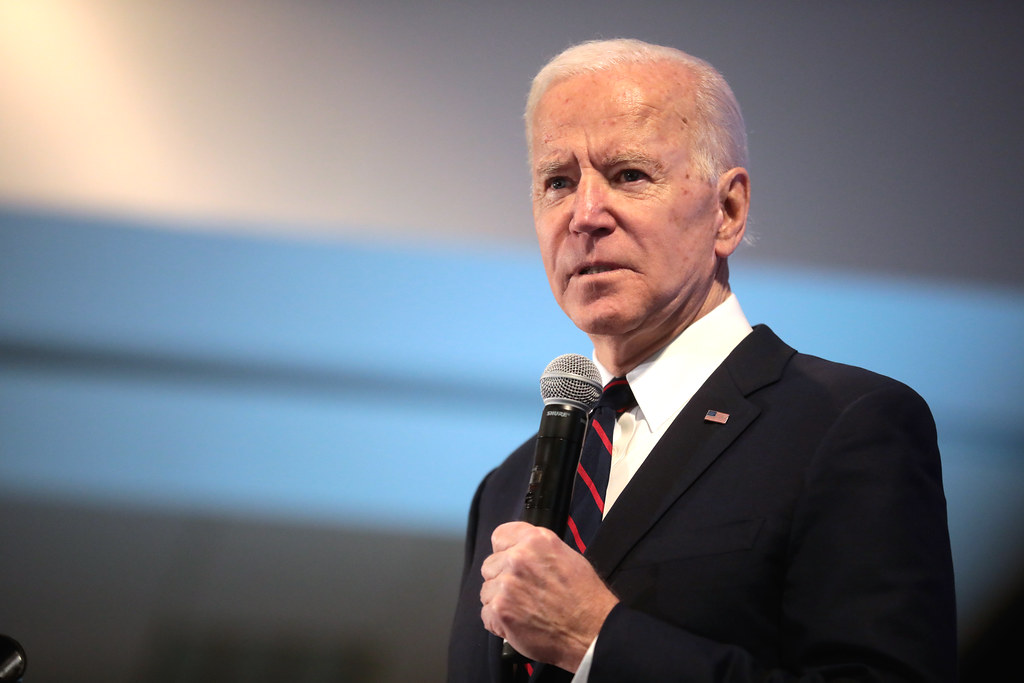
Image of Joe Biden via Creative Commons. “Joe Biden” by Gage Skidmore is licensed under CC BY-SA 2.0

Of course, Biden has said so himself. In his acceptance speech during the Democratic National Convention, Biden said the United States faces “four historic crises.” These crises are the global COVID-19 pandemic that continues to worsen in the United States; an economy shaken by the pandemic; climate change; and continuing racial injustice underlined by police killings of Black Americans. 

Addressing these crises with the country’s people and political leadership on the same page would be tough enough. But of course, the United States is deeply divided. Biden faces the possibility that progressive policies will be struck down by a Supreme Court that has a 6-3 conservative majority following the effective steal of a Court seat by the GOP completed by the confirmation of Amy Coney Barrett in October. And whether progressive legislation will make its way through Congress to Biden’s desk at all depends in part on whether Democrats retake the Senate. Senate control, in turn, will come down to runoff elections in Georgia. 

Further, Trumpism as a political force remains strong. At the moment, the popular vote tally shows that nearly 74 million Americans voted for Trump; Biden’s popular vote advantage, while not insignificant, is not the powerful refutation of the far-right that progressives hoped for. And it is difficult at first glance to see how progressives can further erode far-right support because of the U.S.’ deep polarization that falls along a rural-urban divide and is exacerbated both by social media and lack of trust in traditional news media.

Biden himself has limited means to address this division and hostility among Americans. After all, Barack Obama did everything he could in the name of unity during his time in office and got the Tea Party and birtherism in return. Biden will have greater success avoiding demonization by the right solely because of the color of his skin; nevertheless, Republican leaders will do what they can to hurt Biden. Surely it would be wrong for Biden to compromise his agenda and moderate his policies in search of an elusive bipartisanship. Instead, he should continue appealing to common values and speaking a common language in his public messaging. Biden doesn’t have to act like a unifier because that is what he is; he just can’t assume that the GOP will follow suit. If there is going to be a political thaw, it will come from small-scale grassroots initiatives rather than from Biden’s efforts alone. 

Despite the division, Biden must act in response to the crises we face. Addressing the COVID-19 pandemic, achieving a just economic recovery, taking climate action, and realizing racial justice are necessary. We have to hope that enacting meaningful change leads to greater public support for the Biden administration. 

There is also a larger challenge that transcends Joe Biden and this election. It is the challenge of moving from a society that almost exclusively values economic growth to one that focuses on the wellbeing of all people and the ecosystems that we are inextricably a part of [Note 1]. This project is beyond the scope of political leaders, although it is by no means apart from electoral politics.

Perhaps this challenge—our challenge—can provide clarity and focus in this political moment.

[1] In discussing this challenge, I am indebted to the framework of ‘The Great Turning’ as discussed by David Korten and Joanna Macy.

It’s Joe: Biden Set to Challenge Trump in General Election

With Bernie Sanders suspending his presidential campaign on Wednesday, Joe Biden is the last candidate remaining of the twenty-plus who campaigned for the Democratic presidential nomination. The suspense has now ended in a wild primary campaign that began in late 2018.

2020-3

A President Sanders would have meant a welcome move toward social democracy in the U.S. and support for the vital Green New Deal. There were also reasons to be concerned about Sanders, such as his position on international trade that risked hurting developing countries.

The structural change that Sanders promised, representing a departure from the politics of the Obama-era Democratic Party, excited young people and progressives, and his exit from the race is undoubtedly a disappointment for many. But there are still reasons for progressive optimism. As Jamelle Bouie wrote in his New York Times column on March 11:

If Biden goes on to win the White House, there’s real space for the pro-Sanders left to work its will on policy. It can use its influence to steer Biden toward its preferred outcomes. It can fulfill some of its goals under the cover of Biden’s moderation, from raising the minimum wage nationally to pushing the American health care system closer to single-payer.

Bouie makes the case that this is because Sanders has moved the center of the Democratic Party to the left, and Biden will advance the policies supported by the party’s mainstream. 

One question in this presidential election is, quite simply, whether we wish to have a livable planet. While Biden’s climate plan does not match Sanders’, its framing—such as the acknowledgment that “the Green New Deal is a crucial framework for meeting the climate challenges we face”—reflects the success of the climate justice movement in pushing even comparative moderates like Biden toward something resembling a reckoning with the crisis.

Donald Trump has not only failed to take the necessary action to combat climate change, he has done everything in his power to make the crisis worse. Preventing runaway climate change in the small window of time that we have left requires replacing Trump in November. To win climate justice, activists would need to push a Biden administration every day and every hour. There is a serious risk that he would not do enough to prevent catastrophe. But with Biden we would have a fighting chance, and that makes all the difference.

Notes: September Democratic Debate

The third Democratic presidential debate—and the first with the top 10 candidates together on one stage for one night—was lively and often substantive, although not without its share of oddball moments. Below is my subjective list of some key moments from and elements of the debate. All quotes are taken from The Washington Post’s debate transcript.

2020-3

(Full debate video)

Candidates: former Vice-President Joe Biden, Senator Cory Booker, South Bend, IN Mayor Pete Buttigieg, former Housing and Urban Development Secretary Julián Castro, Senator Kamala Harris, Senator Amy Klobuchar, former Representative Beto O’Rourke, Senator Bernie Sanders, Senator Elizabeth Warren, and former tech executive Andrew Yang.

The shadow of gun violence: Two shootings in Texas last month, including the white supremacist terrorist attack in El Paso, loomed over the debate, which took place in Houston. Several candidates praised Beto O’Rourke’s response to the El Paso attack, and O’Rourke defended his support for a mandatory buy-back of all AR-15 and AK-47 weapons.

Tough questions: Moderator Linsey Davis, of ABC, asked Kamala Harris about criminal justice reform:

Senator Harris, you released your plan for that just this week. And it does contradict some of your prior positions. Among them, you used to oppose the legalization of marijuana; now you don’t. You used to oppose outside investigations of police shootings; now you don’t. You’ve said that you changed on these and other things because you were, quote, “swimming against the current, and thankfully the currents have changed.”

But when you had the power, why didn’t you try to effect change then?

Harris argued that she did try to effect change during her legal career, but it remains to be seen whether those who want to fundamentally change a racist criminal justice system will be able to trust Harris. Davis also questioned Amy Klobuchar’s response to police killings of black Americans during her time as a prosecutor.

To Joe Biden, Davis said:

Mr. Vice president, I want to come to you and talk to you about inequality in schools and race. In a conversation about how to deal with segregation in schools back in 1975, you told a reporter, “I don’t feel responsible for the sins of my father and grandfather, I feel responsible for what the situation is today, for the sins of my own generation, and I’ll be damned if I feel responsible to pay for what happened 300 years ago.”

You said that some 40 years ago. But as you stand here tonight, what responsibility do you think that Americans need to take to repair the legacy of slavery in our country?

Biden said in part, in the context of improving educational outcomes, “[w]e bring social workers in to homes and parents to help them deal with how to raise their children.” The response was heavily criticized by Time Magazine editor-at-large Anand Giridharadas, who wrote on Twitter, “[a]sked about his past comments denying responsibility, as a white man, for America’s sins, he gives an answer insinuating that black parents don’t know how to raise kids.” (h/t to this Politico article).

Jorge Ramos, of Univision, was also tough:

Vice President Biden, as a presidential candidate, in 2008, you supported the border wall, saying, “Unlike most Democrats, I voted for 700 miles of fence.” This is what you said.

Then you served as vice president in an administration that deported 3 million people, the most ever in U.S. history. Did you do anything to prevent those deportations? I mean, you’ve been asked this question before and refused to answer, so let me try once again. Are you prepared to say tonight that you and President Obama made a mistake about deportations? Why should Latinos trust you?

Biden later said that “[t]he president did the best thing that was able to be done at the time.” Julián Castro argued that Biden “wants to take credit for Obama’s work, but not have to answer to any questions.” Biden replied, “I stand with Barack Obama all eight years, good, bad and indifferent. That’s where I stand. I did not say I did not stand with him.”

Ramos also asked candidates about their foreign policy in regard to Latin America, beginning with Bernie Sanders:

Senator Sanders, one country where many immigrants are arriving from is Venezuela. A recent U.N. fact-finding mission found that thousands have been disappeared, tortured and killed by government forces in Venezuela.

You admit that Venezuela does not have free elections, but still you refuse to call Nicolas Maduro a dictator — a dictator. Can you explain why?

And what are the main differences between your kind of socialism and the one being imposed in Venezuela, Cuba and Nicaragua?

On Venezuela, Sanders replied:

Well, first of all, let me be very clear. Anybody who does what Maduro does is a vicious tyrant. What we need now is international and regional cooperation for free elections in Venezuela so that the people of that country can make — can create their own future.

For the most part, the candidates have not yet laid out specifics for how they would respond to global issues like the crisis in Venezuela. Where do they stand on sanctions? Drone strikes? Response to genocide and other atrocities?

Warren on foreign policy: One of the most specific discussions about foreign policy in the debate was on the war in Afghanistan. Elizabeth Warren made an important contribution, and her response outlined some larger themes in her approach to foreign policy. Asked whether she would “bring the troops home starting right now with no deal with the Taliban,” she responded:

Yes. And I’ll tell you why. What we’re doing right now in Afghanistan is not helping the safety and security of the United States. It is not helping the safety and security of the world. It is not helping the safety and security of Afghanistan. We need to bring our troops home.

And then we need to make a big shift. We cannot ask our military to keep solving problems that cannot be solved militarily.

We’re not going to bomb our way to a solution in Afghanistan. We need to treat the problem of terrorism as a worldwide problem, and that means we need to be working with all of our allies, our European allies, our Canadian allies, our Asian allies, our allies in Africa and in South America. We need to work together to root out terrorism.

It means using all of our tools. It means economic investment. It means expanding our diplomatic efforts instead of hollowing out the State Department and deliberately making it so we have no eyes and ears in many of these countries. We need a foreign policy that is about our security and about leading on our values.

In response to a follow-up question, Warren continued:

I was in Afghanistan with John McCain two years ago this past summer. I think it may have been Senator McCain’s last trip before he was sick. And I talked to people — we did — we talked to military leaders, American and local leaders, we talked to people on the ground and asked the question, the same one I ask on the Senate Armed Services Committee every time one of the generals comes through: Show me what winning looks like. Tell me what it looks like.

And what you hear is a lot of, “Uh,” because no one can describe it. And the reason no one can describe it is because the problems in Afghanistan are not problems that can be solved by a military.

I have three older brothers who all served in the military. I understand firsthand the kind of commitment they have made. They will do anything we ask them to do. But we cannot ask them to solve problems that they alone cannot solve.

We need to work with the rest of the world. We need to use our economic tools. We need to use our diplomatic tools. We need to build with our allies. And we need to make the whole world safer, not keep troops bombing in Afghanistan.

Climate crisis shortchanged: After a promising CNN town hall on the climate crisis earlier this month, there were only a few minutes of questions about climate during this debate. Given the magnitude of the issue and the important differences between the candidates’ climate plans, activists are continuing to call for a climate debate. For now, these are a few resources for determining candidates’ positions on climate: My Climate Candidate, Greenpeace rankings, 350 Action rankings.

What Did We Learn From the First Democratic Debates?

Last week, the interminable 2020 U.S. presidential election entered a new phase as 20 Democratic candidates over the course of two nights debated each other in Miami, Florida. Here, I’ll note some of the key policy positions staked out by the candidates during the debates.2020-3

Night One (Video, Transcript)

Candidates: Senator Cory Booker, former Housing and Urban Development Secretary Julián Castro, New York City Mayor Bill de Blasio, former Representative John Delaney, Representative Tulsi Gabbard, Washington Governor Jay Inslee, Senator Amy Klobuchar, former Representative Beto O’Rourke, Representative Tim Ryan, and Senator Elizabeth Warren.

Immigration

Julián Castro pledged to immediately end Donald Trump’s zero-tolerance, remain in Mexico, and metering policies. He also said he would pass an immigration reform law within 100 days “that would honor asylum claims, that would put undocumented immigrants—as long as they haven’t committed a serious crime—on a pathway to citizenship.” He also supported “a Marshall Plan” for El Salvador, Guatemala, and Honduras, and called for the repeal of section 1325 of the Immigration and Nationality Act, which makes crossing the U.S. border without documentation a criminal offense.

In perhaps the most memorable moment of the night, Castro criticized Beto O’Rourke for failing to include the repeal of 1325 in his immigration policy. O’Rourke supported citizenship for DREAMers, called for a “family case management program” rather than detaining families, and backed investment “in solutions in Central America.” O’Rourke said that he introduced legislation in Congress to decriminalize crossing the border for asylum-seekers, but did not commit to applying this standard to all undocumented people.

Cory Booker said that as president he would re-instate DACA, preserve Temporary Protected Status (TPS), make “major investments in the Northern Triangle,” and end ICE raids across the U.S. that separate undocumented immigrants from their families. Jay Inslee said that immigrant and refugee children should be released from detention pending their hearings. Tim Ryan expressed support for repealing section 1325, while Amy Klobuchar supported returning to the 2013 immigration bill as the starting point for future legislation.

Climate Crisis

Inslee brought up green jobs during a discussion of the economy, saying, “we know that we can put millions of people to work in the clean energy jobs of the future.” Ryan added, “[w]e need an industrial policy saying we’re going to dominate building electric vehicles, there’s going to be 30 million made in the next 10 years. I want half of them made in the United States. I want to dominate the solar industry and manufacture those here in the United States.” Elizabeth Warren continued, “[w]e need to go tenfold in our research and development on green energy going forward. And then we need to say any corporation can come and use that research. They can make all kinds of products from it, but they have to be manufactured right here in the United States of America.”

Later in the debate, the moderators turned the discussion to climate change directly. Inslee said addressing the climate crisis should be “the top priority of the United States, the organizing principle to mobilize the United States” and promised to “put 8 million people to work.” O’Rourke pledged to “fund resiliency” in U.S. communities on the frontlines of climate change, “mobilize $5 trillion in this economy over the next 10 years,” and pay “farmers for the environmental services that they want to provide.” He said these steps would prevent an additional 2 degrees Celsius of global warming. Castro committed to re-joining the U.S. in the Paris Agreement on climate. John Delaney supported a carbon tax plan which would include “a dividend back to the American people.”

Criminal Justice

Booker said, “our country has made so many mistakes by criminalizing things—whether it’s immigration, whether it’s mental illness, whether it’s addiction.” Castro claimed that he is “the only candidate so far that has put forward legislation that would reform our policing system in America.”

Foreign Policy 

In a show of hands, all candidates except for Booker indicated that they would bring the U.S. back into the Iran nuclear agreement “as it was originally negotiated.” Booker said that the U.S. should not have pulled out of the deal as it was, but as president he would negotiate a better deal if he had the opportunity. Klobuchar said that she would ask Congress to authorize military force before entering into a conflict. Tulsi Gabbard opposed war with Iran.

Later in the debate, moderator Lester Holt read a viewer question: “does the United States have a responsibility to protect in the case of genocide or crimes against humanity? Do we have a responsibility to intervene to protect people threatened by their governments even when atrocities do not affect American core interests?” O’Rourke answered, “yes, but that action should always be undertaken with allies and partners and friends.” Bill de Blasio argued that the U.S. “should be ready” to intervene in the case of genocide, “but not without congressional approval.”

Ryan suggested that he supports U.S. troops remaining in Afghanistan, while Gabbard called for troops to be withdrawn.

Healthcare

In a show of hands, de Blasio and Warren indicated that they supported abolishing private health insurance. Warren made clear that she is “with Bernie on Medicare for All.” Booker also supported Medicare for All, while Klobuchar, Delaney, and O’Rourke spoke out against abolishing private insurance.

Castro affirmed that his healthcare plan would cover abortion, and said he “would appoint judges to the federal bench that understand the precedent of Roe v. Wade.” Inslee said that insurance companies should not be allowed to deny coverage for abortion. Warren said that she would ensure “that every woman has access to the full range of reproductive health care services” including abortion and birth control. She also supported making Roe v. Wade a law.

Economic Policy

Klobuchar supported free community college; a doubling of Pell Grants ($6,000/year to $12,000/year) and expansion of who qualifies to include “families that make up to $100,000.” O’Rourke dodged a question about whether he supports a 70% marginal tax rate but pledged to tax capital at the same rate as other income and raise the corporate tax rate to 28%. Booker said he would “appoint judges that will enforce” anti-trust law and direct the Department of Justice and Federal Trade Commission to check corporate consolidation. Castro supported the Equal Rights Amendment and “legislation so that women are paid equal pay for equal work.” De Blasio called for “a 70 percent tax rate on the wealthy,” free pre-K and public college, a $15 minimum wage, and breaking up large corporations “when they’re not serving our democracy.” Delaney supported “a doubling of the earned income tax credit, raising the minimum wage, and creating paid family leave.” Inslee said he has “a plan to reinvigorate collective bargaining.”

Gun Violence

Warren supported universal background checks, banning “the weapons of war,” and conducting additional research on how to achieve greater safety considering the guns already present in communities. Castro said that he would support bypassing the filibuster in the Senate if necessary to pass gun reform. Ryan called for “trauma-based care in every school” to prevent violence committed by young people. O’Rourke indicated support for universal background checks, red flag laws, and banning the sale of assault weapons. Klobuchar said that she supported an assault weapons ban as a prosecutor. Booker proposed requiring licenses to buy guns. De Blasio stated, “if we’re going to stop these shootings, we want to get these guns off the street, we have to have a very different relationship between our police and our community.”


Night Two (Video, Transcript)

Candidates: Senator Michael Bennet, former Vice-President Joe Biden, South Bend, IN Mayor Pete Buttigieg, Senator Kirsten Gillibrand, Senator Kamala Harris, former Colorado Governor John Hickenlooper, Senator Bernie Sanders, Representative Eric Swalwell, author Marianne Williamson, and former tech executive Andrew Yang.

Racial Injustice

Probably the most significant moment of the night was an exchange between Kamala Harris and Joe Biden in which Harris challenged Biden’s recent statements and political history on segregation. Harris said to Biden, “it was hurtful to hear you talk about the reputations of two United States senators who built their reputations and career on segregation of race in this country. And it was not only that, but you also worked with them to oppose bussing. And you know, there was a little girl in California who was part of the second class to integrate her public schools, and she was bussed to school every day, and that little girl was me.” Biden said that Harris had mischaracterized his position, adding, “you would’ve been able to go to school the same exact way because it was a local decision made by your city council.” Harris asked Biden, “do you agree today that you were wrong to oppose bussing in America then?” Biden responded, “I did not oppose bussing in America. What I opposed is bussing ordered by the Department of Education.” With Biden making clear that he had opposed federal action to desegregate schools through bussing, Harris made the classic progressive argument that states’ rights should not be used as a cover to protect injustice.

Following the police shooting of Eric Logan, a black man, in South Bend, Indiana, moderator Rachel Maddow asked Pete Buttigieg why the number of black police officers had not increased under his watch as mayor (Maddow noted that the police force is “6 percent black in a city that is 26 percent black”). Buttigieg responded, “[b]ecause I couldn’t get it done.” He continued, “until we move policing out from the shadow of systemic racism, whatever this particular incident teaches us, we will be left with the bigger problem of the fact that there is a wall of mistrust put up one racist act at a time.” Eric Swalwell said that Buttigieg should have fired the chief of police, and John Hickenlooper claimed that during his time as mayor of Denver, the city accomplished what South Bend has not. He said, “I think the real question that America should be asking is why five years after Ferguson, every city doesn’t have this level of police accountability.”

Marianne Williamson supported reparations for slavery, and Michael Bennet said that “the attack on voting rights in [Supreme Court decision] Shelby v. Holder is something we need to deal with.”

Economic Policy

Bernie Sanders called for free public college, and the elimination of student loan debt to be paid for by “a tax on Wall Street.” Biden pledged to “make massive cuts” in tax loopholes and end “Trump’s tax cuts for the wealthy.” On education, he said he would triple spending for Title 1 schools, implement universal pre-K and free community college, and freeze student debt and interest payments for people earning under $25,000/year. Harris committed to repealing the 2017 Republican tax law and providing a tax credit of “up to $500 a month” to families making under $100,000/year. She also called for a “middle class and working families tax cut.” Buttigieg supported “free college for low and middle-income students for whom cost could be a barrier,” the ability to refinance student debt, and raising the minimum wage “to at least $15 an hour.” Andrew Yang supported a universal basic income plan to provide payments of $1,000/month, which would be paid for in part by implementing a value-added tax. Kirsten Gillibrand called for “a family bill of rights that includes a national paid leave plan, universal pre-K, affordable daycare, and making sure that women and families can thrive in the workplace no matter who they are.”

Healthcare

Sanders supported Medicare for All and committed to reducing prescription drug prices by 50%. Hickenlooper and Bennet opposed abolishing private insurance. Bennet supported the Medicare X plan. In a show of hands, only Sanders and Harris indicated that they would abolish private insurance (Harris said on Friday that she had misheard the question and clarified that she favored Medicare for All without abolishing private insurance). Gillibrand emphasized that the Medicare for All plan would have a transition period to single-payer. She suggested that private insurance companies could try to compete with the government health plan, but likely would be unable to do so successfully. Buttigieg supported a “Medicare for all who want it” plan. Biden advocated building on Obamacare and providing an accessible plan similar to Medicare on insurance exchanges. He also said that the government should negotiate drug prices for those on Medicare, and called for jailing insurance executives for misleading advertising, “what they’re doing on opioids,” and bribing doctors. In a show of hands, all candidates indicated that their healthcare plans would cover undocumented people in the U.S.

Sanders said, “a woman’s right to control her own body is a constitutional right” and pledged to only appoint justices to the Supreme Court who support Roe v. Wade. He asserted, “Medicare for All guarantees every woman in this country the right to have an abortion.” Gillibrand opposed the Hyde Amendment and said she would “guarantee women’s reproductive freedom” when making deals as president.

Immigration

Buttigieg commented, “[t]he American people want a pathway to citizenship. They want protections for DREAMers. We need to clean up the lawful immigration system… And as part of a compromise, we can do whatever commonsense measures are needed at the border.” Harris committed to reinstating DACA, deferring deportation for veterans and parents of DREAMers, eliminating private detention centers, beginning “a meaningful process for reviewing the cases for asylum,” and releasing “children from cages.” Hickenlooper called for ICE to be “completely reformed” and said there should be “sufficient facilities in place so that women and children are not separated from their families. The children are with their families.” Williamson criticized the other candidates for not discussing U.S. foreign policy in Latin America. Gillibrand said, “I would reform how we treat asylum-seekers at the border. I would have a community-based treatment center,” provide lawyers to asylum-seekers, and utilize judges who are “not employees of the Attorney General but appointed for life.” Gillibrand also said she “would fund border security,” stop funding private detention centers, and support “comprehensive immigration reform with a pathway to citizenship.”

In a show of hands question, Buttigieg, Gillibrand, Harris, Swalwell, Williamson, and Yang indicated support for making border crossing a civil rather than criminal offense. Bennet did not raise his hand, Hickenlooper’s position was unclear because the camera moved away from him, while Biden and Sanders pointed a finger, presumably indicating that they wanted to elaborate on the question. Later, Biden said he would reunite families who have been separated and send “billions of dollars worth of help to the region immediately.” When pressed by moderator José Díaz-Balart, Biden said that an undocumented person who had not committed any crimes “should not be the focus of deportation.” He also said the U.S. “should immediately have the capacity to absorb” asylum-seekers and “keep them safe until they can be heard.” Sanders said he would “rescind” all Trump policies on immigration and convene a summit with the presidents of countries in Central America. Swalwell opposed deporting undocumented people who do not have criminal records. Harris said she disagreed with President Obama’s policy “to allow deportation of people who, by ICE’s own definition, were non-criminals.” She emphasized that it is necessary for the victims of rape to be able to report the crime committed against them without fear of deportation. Bennet touted the 2013 immigration bill which he co-wrote.

Gun Violence

Swalwell committed to a “ban and buyback of every single assault weapon in America.” Sanders called for universal background checks, an end to the gun show loophole and straw man provision, and a ban on assault weapons. When pressed by Swalwell, he appeared to support the buyback of assault weapons as well. Harris said she would give Congress 100 days to pass gun legislation, and take executive action if the deadline passed. She supported background checks, a ban on the importation of assault weapons, and said she would require the Bureau of Alcohol, Tobacco, and Firearms to take the licenses of gun dealers who violate the law. Biden called for smart guns that require a user’s biometric features and a buyback of assault weapons.

Climate Crisis

Harris supported the Green New Deal and re-entering the U.S. into the Paris Agreement. Buttigieg supported a carbon tax with a dividend that would be “rebated out to the American people in a progressive fashion.” He called for “the right kind of soil management and other… investments” in the rural U.S. and re-entering the Paris Agreement. Biden committed to building 500,000 new recharging stations to reach “a full electric vehicle future” by 2030. He supported re-entering the Paris Agreement and investing $400 million “in new science and technology.” Williamson supported the Green New Deal.

Foreign Policy

Bennet called for restoring relationships with U.S. allies. Sanders argued that it is necessary to rebuild “trust in the United Nations and understand that we can solve conflicts without war but with diplomacy.” Sanders opposed war with Iran, and said he “helped lead the effort for the first time to utilize the War Powers Act to get the United States out of the Saudi-led intervention in Yemen, which is the most horrific humanitarian disaster on Earth.” Gillibrand said she would “engage Iran to stabilize the Middle East and make sure we do not start an unwanted never-ending war.” Biden supported the withdrawal of combat troops from Afghanistan.

EU Elections: Background and Results

Europeans went to the polls from May 23-26 to vote for a new European Parliament and, indirectly, European Commission President. At stake is the role of the EU and its response to issues like the climate crisis, economic policy, and migration.

Results

All 2019 results and statistics based on the numbers listed at election-results.eu as of 5/27/19.

  • The two largest groups in the European Parliament–European People’s Party (EPP) and Progressive Alliance of Socialists and Democrats (S&D)–are projected to have lost ground to the Greens, liberal parties, and the far-right.
  • Average voter turnout was the highest since 1994 at 50.9%, up from 42.6% during the last election in 2014.
  • EPP is projected to have won 180 seats, remaining the largest party in parliament despite losing 41 seats compared to 2014. Lead candidate Manfred Weber has suggested that this gives him the authority to be the next European Commission President.
  • S&D has won an estimated 146 seats. The center-left is projected to have gained in Spain, Portugal, and the Netherlands, but saw disappointing results in Germany, France, and the UK.
  • The centrist Alliance of Liberals and Democrats for Europe (ALDE), in combination with French President Emmanuel Macron’s Renaissance list, have taken 109 seats, up from 67 in 2014. How the ALDE might change with the addition of Macron’s allies, and what other national parties might join a reshaped group, remains to be seen.
  • The Greens-European Free Alliance (Greens-EFA) are projected to win 69 seats, adding 19 compared to 2014. The Greens in Germany won second place after the governing Christian Democratic Union, beating out the Social Democratic Party. Similarly, in France, the EELV party placed third, higher than any other party on the left. The Greens-EFA presented a platform emphasizing the need for the EU to address the climate crisis, and co-leader Bas Eickhout has said he will push for “climate action, social justice and democracy” in negotiations to determine the next Commission President. An AFP article notes, “[w]ith the two main traditional EU blocs… projected to lose ground, the Greens could end up as kingmaker in the European Parliament.”
  • The far-right group including the Lega party in Italy and the National Rally in France will win an estimated 58 seats, while the group including the new Brexit Party in the UK and the Five Star Movement in Italy is projected to take 54 seats. Matteo Salvini’s Lega party handily won the most votes in Italy, with 34.3% and 28 seats out of 73. In France, Marine Le Pen’s National Rally party narrowly beat the Renaissance list backed by Macron, taking 22 of 74 seats.
  • In Hungary, the far-right Fidesz party of Prime Minister Viktor Orbán won a majority of votes and 13 of 21 seats. In Poland, the far-right Law and Justice Party won 26 of 51 seats, while the European Coalition list took 22.
  • The European Conservatives and Reformists (ECR) and the European United Left/Nordic Green Left (GUE/NGL) both had disappointing results–ECR is estimated to have won 59 seats and the GUE/NGL 39.
  • In the UK, the election serves as further evidence of how divided politics has become following 2016’s Brexit referendum. On Friday, as voters in the UK went to the polls, Prime Minister Theresa May announced her plan to resign after three years of being unable to negotiate a deal to leave the EU. The results of the election indicate that many are willing to leave even without a deal–Nigel Farage’s Brexit party won the most seats with 29 out of 73, 31.7% of the vote. However, parties that strongly support remaining in the EU also performed well. Running on the slogan “Bollocks to Brexit,” the Liberal Democrats won the second most seats with 16, and the Green Party jumped from 3 to 7 seats. The Green Party will be joined by three representatives from the Scottish National Party and one from Plaid Cymru in the Greens-EFA parliamentary group. Despite leading the country, the Conservative Party won only 8.7% and 4 seats, while the Labour Party took 10 seats.

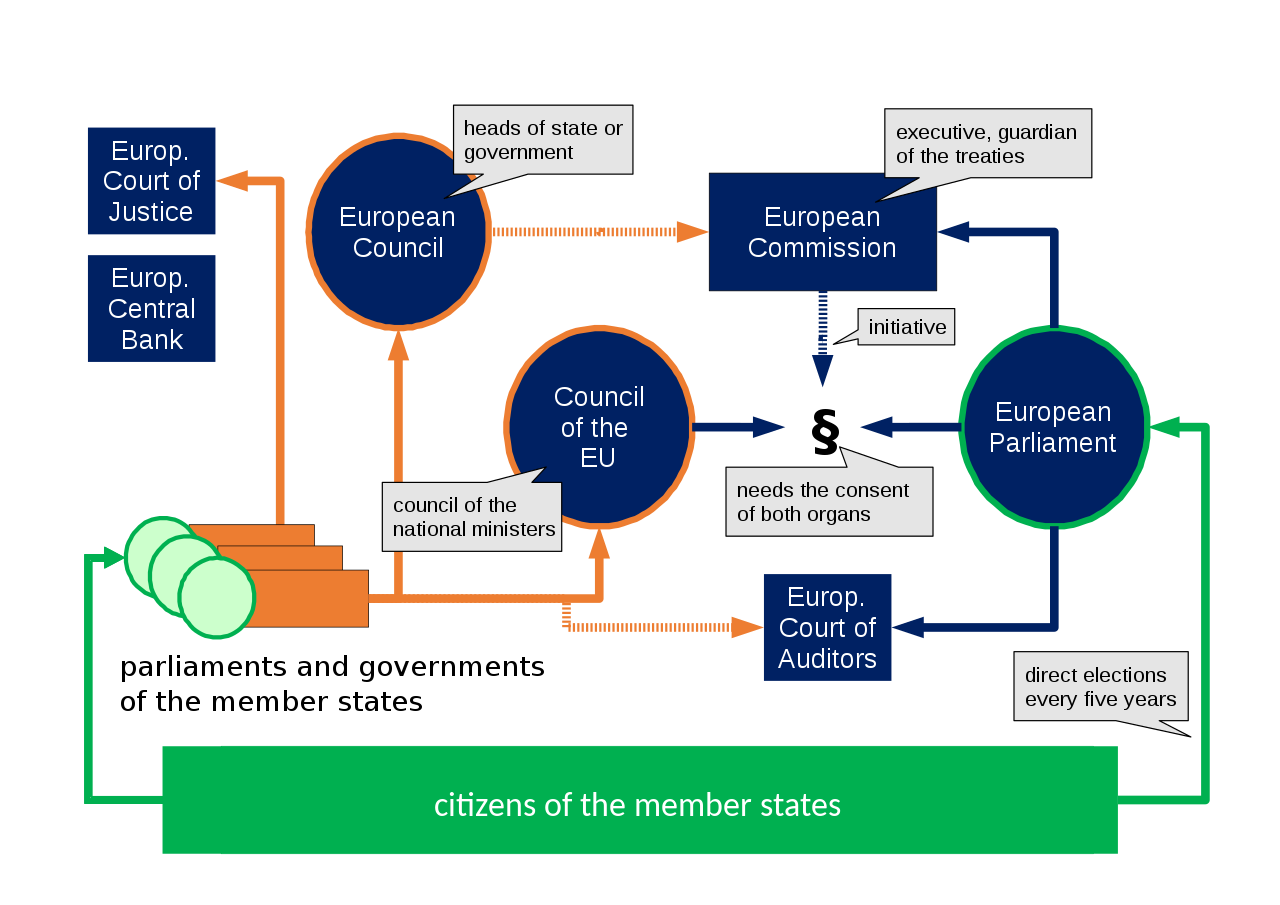
1280px-Organs_of_the_European_Union.svg.png
The structure of the European Union. In the EU elections, the European Parliament and European Commission are in play. (Image by Ziko van Dijk via Wikimedia Commons)

Context

Pew Research Center’s Global Attitudes Survey from spring, 2018 provides an idea of Europeans’ attitudes about migration (of immigrants and refugees) and the economy. A median of 51% of respondents across ten EU countries said “their country should allow fewer immigrants into their country or none at all” compared to only 10% who favored greater immigration (35% said “about the same” number). However, a median of 77% support “taking in refugees from countries where people are fleeing violence and war,” with only 21% opposed. According to the Missing Migrants Project, 7,101 people have died attempting to cross the Mediterranean Sea into Europe since 2015. Yet, the trend in European countries over the same time period has been toward shutting people out.

A median of 50% surveyed across the ten countries said “compared with 20 years ago, the financial situation of average people in our country is worse,” versus only 31% who said it was “better” and 15% who observed “no change.” The three countries where respondents had the worst outlooks were Greece (87% “worse”), Italy (72%), and Spain (62%). These southern European countries were hit the hardest by the 2008 financial crisis and then by EU-mandated austerity measures.

The far-right has capitalized on this sentiment to become a dangerous and influential force. But they are in no position to take power at the EU level. As of Friday, Politico.eu predicted that a new EU parliamentary group led by Italian Deputy Prime Minister Matteo Salvini would win 73 seats, with a group combining the British Brexit Party and the Italian Five Star Movement taking 48. That’s significant, but only 121 out of 751 seats in total.

There is also reason for optimism at the grassroots level. On Friday, the second Global Strike for Climate hit cities in Europe and around the world, the latest in a series of school walkouts and demonstrations led by young people calling for climate action. At the final debate between candidates for the presidency of the European Commission, the topic of climate change and the environment was introduced with reference to the walkout movement and 16-year old Swedish activist Greta Thunberg, who began the movement last year.

Rules

An idiosyncrasy of EU elections is that while the share of the vote to each parliamentary group will determine the balance of power in the next EU Parliament, each voter will actually cast their ballot for a national party. Most of these national parties are allied with a parliamentary group. So, for example, a vote for the Social Democratic Party in Germany will go towards sending representatives of that party to parliament to form part of the Progressive Alliance of Socialists and Democrats (S&D) group. However, it is possible for representatives to be unaligned with a parliamentary group.

The official procedure for selecting the next European Commission President is that EU member states nominate someone for the job, and that nominee must be approved by a majority of the new Parliament. According to Politico, beginning with the last EU elections in 2014, a system was adopted which encourages the lead candidate of “the party that wins the most seats in the European Parliament” to become president of the Commission. However, that ideal is non-binding. It is foreseeable that a coalition could be formed between parties that did not win the most votes but were able to cobble together a 376-seat majority. In that scenario, the lead candidate of the largest party in the coalition could become European Commission President. It is also possible that someone else altogether will be chosen as the next Commission president. For example, Emmanuel Macron has said that Michel Barnier, the EU’s lead negotiator of Brexit, should be considered. The EU is an unwieldy institution that is constantly in flux, and the procedure for determining the Commission President reflects that.

Note: A previous version of this post omitted the role of EU member states in nominating the European Commission President.

Climate Politics: Challenges and Opportunities

It’s been an odd few weeks for climate politics. First, the good news: following the U.S. midterm elections, Representative-elect Alexandria Ocasio-Cortez proposed forming a congressional Select Committee on a Green New Deal. This committee would be in charge of writing a plan and draft legislation for “a detailed national, industrial, economic mobilization plan… for the transition of the United States economy to become greenhouse gas emissions neutral” within 10 years (read the full proposal here). Although you might not imagine that a temporary congressional committee would generate much enthusiasm outside of Washington, activists have recognized the critical importance of this proposal in the larger fight for climate action: it’s a last-ditch attempt to get something big in motion before the clock runs out. To push a recalcitrant Democratic Party to support the committee, young activists have held sit-ins at the offices of leading Democrats like Nancy Pelosi. The wait is still on as to whether the proposal has enough support, at least in the House of Representatives where Democrats will have a majority in the next session.

The chasm between the climate policy of progressive Democrats and the Trump administration was highlighted this month at the Conference of Parties (COP) 24 climate talks in Poland. The U.S. delegation, along with Kuwait, Russia, and Saudi Arabia, opposed language that would “welcome” the October IPCC report emphasizing the importance of stopping global temperature rise at 1.5 degrees Celsius (instead, those states wanted to simply “note” the report). Meanwhile, as most of the world tried to figure out how the “rulebook” for drawing back carbon emissions should be written, the Trump administration proposed a “rollback of an Obama-era rule that effectively blocked new construction of coal-fired power plants” and the opening of “some nine million acres of public lands in Western states to oil and gas drilling,” according to the New Yorker‘s Elizabeth Kolbert. And that wasn’t the only bad news to break during the summit—a Global Carbon Project report projected that global carbon dioxide emissions will rise by approximately 2.7% in 2018, “the largest increase in seven years.”

In the end, the COP24 summit did agree to a “rulebook” for carrying out the 2015 Paris Agreement. But climate advocacy groups say the outcome of the summit was not nearly sufficient. In a press release by the group 350.org, Executive Director May Boeve says, “[b]y refusing to acknowledge what needs to be done before it’s too late and making the tiniest of tiny baby-steps of progress, politicians have pushed this climate COP toward irrelevance.” Boeve points instead to the fossil fuel divestment movement as a sign of hope. Ahead of the summit, the movement reached its 1,000th institutional commitment to divest from fossil fuels. Among those 1,000 institutions include the cities of New York and Berlin, the insurance company Axa, the Norwegian Sovereign Wealth Fund, the Rockefeller Brothers Fund, and the country of Ireland (combined, the 1,000 institutions have almost $8 trillion in total investments). 350.org co-founder Bill McKibben writes that the divestment movement has imposed real social and economic costs on fossil fuel companies, and while “[d]ivestment by itself is not going to win the climate fight… by weakening – reputationally and financially – those players that are determined to stick to business as usual, it’s one crucial part of a broader strategy.”

A not-so-popular approach to fighting climate change was the fuel tax proposed by French President Emmanuel Macron and then scrapped following the massive Yellow Vests protest movement. Although the movement was sparked by the proposed tax, it has developed into a broader uprising against France’s political and economic structure, with demands that “include a redistribution of wealth as well as the increase of salaries, pensions, social security payments and the minimum wage,” according to journalist Rokhaya Diallo. Diallo argues that the Yellow Vests movement should not be viewed as anti-climate, but instead as anti-neoliberal. As Amnesty International Secretary General Kumi Naidoo writes, “[p]rotecting people’s livelihoods, enabling them to live their life in dignity, and stopping climate change are in fact part of one and the same struggle.”

So, how to move forward for both people and planet in the short amount of time we have left? Well, the Green New Deal is a good place to start.

U.S. Midterms: Dems Take House, Dividing Control of Congress

Democrats will control the House of Representatives for the first time since 2010; Republicans retain their Senate majority

Americans went to the polls on November 6 after days marked by terror and uncertainty. Anti-Semitic and racist killings, as well as an attempt at political assassinations, have dominated the headlines. President Trump incited hate before and after the violence, his fearmongering over a “migrant caravan” the closing argument of a midterm election campaign that has stretched on for many months.

Many Democrats ran on bread-and-butter issues like healthcare and opposition to the 2017 Republican tax law. But I think many people went to the polls on one or another side of the deep divide that exists in this country. It’s a divide, as Rebecca Solnit puts it in an excellent article, between an exclusive “us” and an inclusive “we.” Donald Trump wasn’t on the ballot, but he has said very clearly that he wanted this election to be about him. And, as he is the most powerful proponent of the politics of exclusion, how could it not be?

The vote is a blunt tool. I haven’t seen a sufficient vision from Democrats on many key problems facing this country, and especially on global issues, which have not been seriously addressed during the campaign. But I voted for the Democrats anyway, in the hope that they will slam the brakes on the Trump agenda. The Democrats need to fight for climate action in the vanishingly few years that we have left, affirm the human rights of oppressed communities in this country, stitch together an effective social safety net, and stop the country’s drift into authoritarianism. Now that they’ve taken the House, they’d better put their foot down.

Here are a few key results from last night, including some historic victories (also see wall-to-wall coverage from CNN, The Guardian, and NPR):

  • A record number of women will serve in congress (118 as of Wednesday afternoon).
  • Deb Haaland (D-NM) and Sharice Davids (D-KS) are the first Native American women elected to congress. Davids will also become Kansas’ first openly LGBTQ member of congress.
  • Ilhan Omar (D-MN) and Rashida Tlaib (D-MI) will become the first Muslim women to serve in congress. Tlaib will also become the first Palestinian-American in congress.
  • Tlaib and Alexandria Ocasio-Cortez (D-NY) will join Bernie Sanders as the only democratic socialists in congress. Cortez and Tlaib both belong to the Democratic Socialists of America, an organization that also made significant gains in state elections last year. Ocasio-Cortez becomes the youngest woman ever elected to congress.
  • Good news from Florida: “Floridians approved a constitutional amendment to automatically restore voting rights to people with felony convictions once they complete their sentences, a historic move expanding the right to vote to about 1.4 million people and reverses a state policy rooted in the Jim Crow South.”
  • And bad news from Florida: Ron DeSantis (R), a reactionary candidate who closely linked himself with Donald Trump, has been elected governor over progressive Democrat Andrew Gillum.
  • Jared Polis (D-CO) is the first openly gay person to be elected governor in the United States.
  • Ayanna Pressley (D-MA) will become the first black congresswoman from Massachusetts.
  • Ted Cruz (R-TX) has held off a challenge from Beto O’Rourke to remain in the Senate.
  • Brian Kemp (R-GA) is leading Democrat Stacy Abrams in a Georgia gubernatorial race that has been marked by voter suppression led by Kemp himself. Georgia law requires the winner to receive over 50% of the vote, and Abrams has said she will not concede until all votes are counted.
  • In one of my hometown districts, NY-19, Democrat Antonio Delgado has unseated John Faso. Faso had attacked Delgado, who is black, for lyrics in a rap album that he released in 2006.
  • NPR reports that Laura Kelly (D-KS) has defeated the racist Kansas Secretary of State Kris Kobach to become the next governor of that state.
  • Tony Evers (D-WI) is projected to become the next governor of Wisconsin, unseating Scott Walker.
  • Democratic Senators in North Dakota, Indiana, and Missouri, all states won by Trump in 2016, have been defeated by their Republican challengers.

Brazil’s Far Right Threat

720px-Flag_of_Brazil.svg.png
via Wikimedia Commons

On October 7, far right candidate Jair Bolsonaro, a former army captain, came within a few percentage points of becoming Brazil’s next president. In a race with many candidates, Bolsonaro advanced with 46% of the vote, just shy of the majority needed to avoid a second round, two-person runoff. Fernando Haddad of the Workers’ Party–a last minute stand-in for former president Luis Inácio Lula da Silva (known as Lula), who was barred from running–also advanced, with 29% of the vote. (Full first-round election results here)

This election is crucial. Bolsonaro is akin to Donald Trump in his misogyny, racism, and homophobia (see here and here), while his praise for the military dictatorship that ruled Brazil from 1964 to 1985 suggests that his presidency could see the return of authoritarian government. Bolsonaro’s running mate, ex-general Hamilton Mourão, said of the dictatorship, “[e]xcesses were committed, heroes kill…”

In 2017, the decisive defeats of Marine Le Pen (France) and Geert Wilders (The Netherlands), suggested that the rest of the world might not jump aboard the far right Trump train. But then, presidential term limits were abolished in China, Vladimir Putin ‘won’ another six-year term in Russia, a nationalist government was formed in Italy, and now Brazil is at risk of joining a growing list of newly illiberal states.

While there are global causes for the rise of Bolsonaro, there are also important local factors. Eliane Brum describes his bases of support as those who hope to benefit from development in the Amazon, anti-same-sex marriage evangelicals, and critics of the Workers’ Party (PT):

These people hate the PT for many reasons. Some because under former presidents Luiz Inácio Lula da Silva and Rousseff, the party reduced poverty, widened university access to black students, and strengthened rights for housemaids – for a long time, a form of modern slavery in Brazil. Others because they cannot forgive a party that rose to power promising change, only to become corrupted and aloof.

Bolsonaro is a political outsider at a time when the ‘Operation Car Wash’ corruption scandal has tarnished the image of Brazil’s major political parties. Although politicians of both the right and the left are alleged to be corrupt, the Workers’ Party has borne the brunt of the fallout. President Dilma Rousseff was impeached in 2016, and Lula, Rousseff’s predecessor and founder of the Workers’ Party, faces twelve years in prison and was barred from running in this election. Fernando Haddad carries the institutional weight of the Workers’ Party and the endorsement of Lula–both a blessing and a curse–while Bolsonaro joined the minor Social Liberal Party only this year as a vehicle for his presidential run.

A Bolsonaro presidency would have grave environmental impacts. He has pledged to pull Brazil out of the Paris climate agreement, which would make Brazil only the second country, after the U.S., to declare its intent to leave the vital global accord. And Bolsonaro’s proposed domestic policy would accelerate the deforestation of the Amazon, limiting the giant rainforest’s ability to absorb CO2. An article in Grist explains,

As the global fight against catastrophic climate change ramps up, forests are a necessary front of the action. According to a dire, new report by the United Nation’s Intergovernmental Panel on Climate Change (IPCC), halting deforestation could play a vital role in limiting global warming to 1.5 degrees Celsius, as forests have a significant capacity to absorb and store carbon.

Of course, in addition to the global threats posed by a potential Bolsonaro presidency, there are numerous threats specific to Brazil. Authoritarianism ultimately jeopardizes all Brazilians, while the candidate’s bigotry threatens marginalized communities in much the same way that Trump’s actions and rhetoric threatens marginalized communities in the United States. Bolsonaro’s promise to gut environmental protections also intersects with his disregard for human rights: “[h]e has criticized the Brazilian government’s commitment to preserving vast swaths of the Amazon for Indigenous people, promising that he will ‘not to give the Indians another inch of land.'” (Grist).

Brazilian democracy is in the fight of its life, but it’s worth ending with a positive. A wave of women-led, anti-Bolsonaro resistance has formed, and similarities with the popular opposition to Trump in the U.S. are clear. Brum again:

In August, Ludimilla Teixeira, a black anarchist born in one of the poorest communities of Salvador, Bahia, created a Facebook page: Women United Against Bolsonaro. The page, which accepts only female followers, now has almost 4 million of them. A movement grew out of this group… [on September 30] spurring hundreds of thousands of women – and men – on to the streets of Brazil and around the world. Many carried banners with the slogan and hashtag: #EleNão – #NotHim. It was the biggest demonstration organised by women in Brazil’s history.

The election’s second round will take place on October 28.