Green Growth?

This post is adapted from an issue of The Weekly Letter, a newsletter I wrote during most of 2022. The newsletter is not currently accessible online, although I aim to archive it on this blog at some point.

Is it possible to address the environmental crises we face while continuing to pursue economic growth? I draw on several pieces referenced by Spencer Bokat-Lindell in his excellent article for The New York Times reviewing the green growth vs. degrowth debate as well as some other sources.

Economic growth—as measured by the indicator Gross Domestic Product (GDP)— has led to exceptional material prosperity, remarkable technologies, and great advancements in health. To take one example, in a Vox article, Kelsey Piper notes that there is a strong correlation between low child mortality and high GDP per capita. But the effects of the growth-focused economic system are not all positive. The growth model has steamrolled alternative economic, and often political, systems, reshaping the whole world in the image of the Global North. There is massive economic inequality, both within and between countries, and many people are unable to meet their basic needs. And most relevant to the question of whether growth can be environmentally sustainable, the growth-focused model has led to environmental crises, including climate change and biodiversity loss, which threaten the planet’s life support systems.

The prevailing approach to addressing environmental crises is known as green growth. Proponents of green growth argue that it is possible to continue growing GDP while also reducing material and energy use and quickly reaching net zero carbon emissions. However, some environmentalists have championed an alternative approach known as degrowth. In a journal article, degrowth proponent Jason Hickel writes, “Degrowth is a planned reduction of aggregate resource and energy use in high-income nations designed to bring the economy back into balance with the living world in a safe, just and equitable way.” Indeed, advocates argue that degrowth is necessary to bring the economy and the planet into balance. Hickel and Giorgos Kallis write in a review of empirical studies of green growth:

“extant empirical evidence does not support the theory of green growth. This is clear in two key registers. (1) Green growth requires that we achieve permanent absolute decoupling of resource use from GDP. Empirical projections show no absolute decoupling at a global scale, even under highly optimistic conditions. While some models show that absolute decoupling may be achieved in high-income nations under highly optimistic conditions, they indicate that it is not possible to sustain this trajectory in the long term. (2) Green growth also requires that we achieve permanent absolute decoupling of carbon emissions from GDP, and at a rate rapid enough to prevent us from exceeding the carbon budget for 1.5°C or 2°C. While absolute decoupling is possible at both national and global scales (and indeed has already been achieved in some regions), and while it is technically possible to decouple in line with the carbon budget for 1.5°C or 2°C, empirical projections show that this is unlikely to be achieved, even under highly optimistic conditions.”

In other words, Hickel and Kallis argue that evidence shows that a growing economy will, first, use more natural resources than is sustainable and, second, likely fail to make the transition away from carbon emissions quickly enough to meet the Paris Agreement targets. For these authors, green growth is an illusion.

(On climate change, a key issue is whether it is appropriate to employ bioenergy with carbon capture and storage (BECCS). Hickel and Kallis write that BECCS “entails growing large tree plantations to sequester CO2 from the atmosphere, harvesting the biomass, burning it for energy, capturing the CO2 emissions at source and storing it underground.” The authors make the case that BECCS is unproven and potentially damaging for people and the planet.)

The social dimension of degrowth is crucial. While high-income countries would switch from a growth-based economic model, low- and medium-income countries would continue to grow their economies until a greater level of wealth is reached. And within high-income countries, degrowth advocates support policies such as job and income guarantees, decommodification of public goods, and democratization of the economy. The premise is that policies like these would prevent a drop in GDP from causing the economic pain and decreased wellbeing that occurs when growth-based economies enter recessions.

As the degrowth argument has gained traction, advocates of green growth have pushed back. Here, I will highlight two critiques of degrowth.

One argument is that degrowth is not politically feasible. Either degrowth will always be a losing battle in high-income countries or, while it may eventually attract enough support to be politically possible, this consensus will not be built in the vanishingly short amount of time we have left to address climate change. Spencer Bokat-Lindell quotes Eric Levitz of New York magazine:

“’Americans might well find themselves happier and more secure in an ultra-low-carbon communal economy in which individual car ownership is heavily restricted, and housing, health care, and myriad low-carbon leisure activities are social rights.’ But, he adds, ‘nothing short of an absolute dictatorship could affect such a transformation at the necessary speed. And the specter of eco-Bolshevism does not haunt the Global North. Humanity is going to find a way to get rich sustainably, or die trying.'”

A second argument is that due to the interconnectedness of the global economy, economic contraction in high-income countries would hamper economic growth in low- and middle-income countries. In the Vox article mentioned earlier, Kelsey Piper writes:

“the pandemic offered a taste of how a sudden drop in rich-world consumption would actually affect the developing world. Covid-19 dramatically curtailed Western imports and tourism for a time. The consequences in poor countries were devastating. Hunger rose, and child mortality followed….

Hickel’s perspective is that most trade between rich and poor countries is extractive, not mutually beneficial — and that maybe when that dynamic ceases, poor countries will have the chance for the catch-up growth they merit. That’s one take. But it means that degrowth’s case for not crushing the poor world is predicated on a speculative take on how those countries can grow — one that democratically elected leaders in those countries largely don’t share.”

If it is true that a decrease in imports by high-income countries would inevitably harm low- and middle-income countries, this undermines degrowth’s commitment to just social outcomes.

As the green growth/degrowth debate rages on, there have been attempts to “reach a truce…” In an article for openDemocracy, Beth Stratford argues that both sides should reach a consensus “on a basic set of demands that can stop us hurtling toward ecological collapse.”

Additionally, degrowth is not the only framework that challenges the growth-based model. Another framework, called doughnut economics, was developed by Kate Raworth. The principle of doughnut economics is that economies’ resource use should be sufficient to meet everyone’s needs without destroying the Earth’s life support systems. Right now, the problem is that “millions or billions of people worldwide still fall short on their most basic of needs” while “we’ve already overshot at least four… planetary boundaries…” For Raworth, it’s necessary to “overcome this structural dependency on growth, so that we can instead focus on thriving and balance within the social and the ecological boundaries of the doughnut.”

The question of whether it is possible to create a just, sustainable world through green growth or whether it is necessary to move to something like degrowth or doughnut economics is complicated and deserves careful consideration. But I think this is precisely the conversation we need to have. And right now, both supporters and opponents of green growth should find where they agree and push for meaningful changes in social and environmental policy.

Biden’s Challenge

Joe Biden will be the 46th President of the United States. He faces a challenge that can hardly be overstated. 

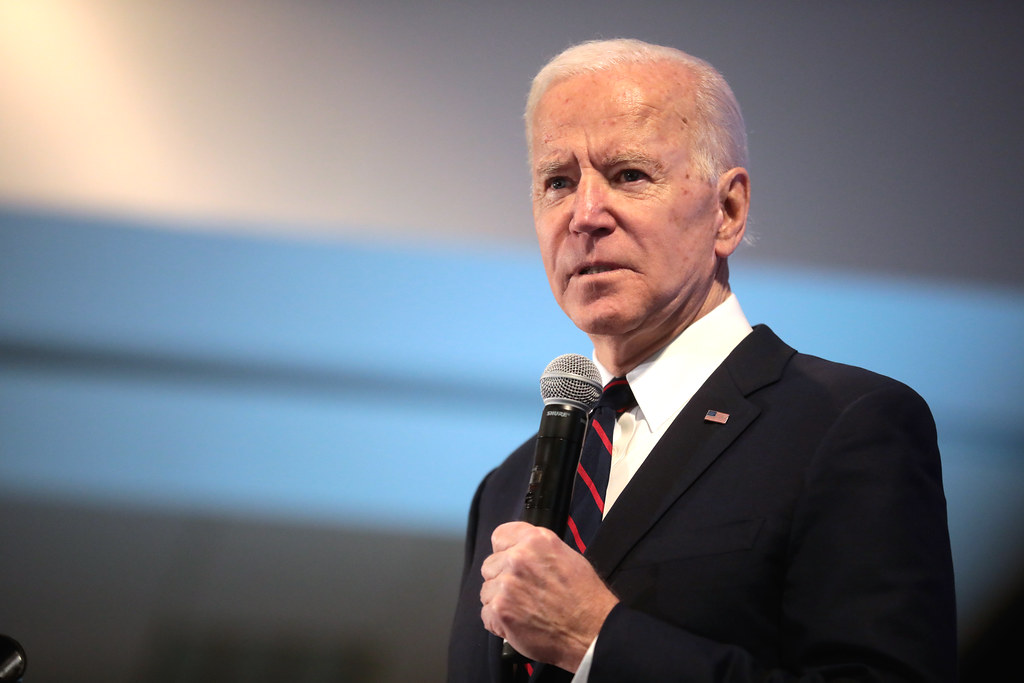
Image of Joe Biden via Creative Commons. “Joe Biden” by Gage Skidmore is licensed under CC BY-SA 2.0

Of course, Biden has said so himself. In his acceptance speech during the Democratic National Convention, Biden said the United States faces “four historic crises.” These crises are the global COVID-19 pandemic that continues to worsen in the United States; an economy shaken by the pandemic; climate change; and continuing racial injustice underlined by police killings of Black Americans. 

Addressing these crises with the country’s people and political leadership on the same page would be tough enough. But of course, the United States is deeply divided. Biden faces the possibility that progressive policies will be struck down by a Supreme Court that has a 6-3 conservative majority following the effective steal of a Court seat by the GOP completed by the confirmation of Amy Coney Barrett in October. And whether progressive legislation will make its way through Congress to Biden’s desk at all depends in part on whether Democrats retake the Senate. Senate control, in turn, will come down to runoff elections in Georgia. 

Further, Trumpism as a political force remains strong. At the moment, the popular vote tally shows that nearly 74 million Americans voted for Trump; Biden’s popular vote advantage, while not insignificant, is not the powerful refutation of the far-right that progressives hoped for. And it is difficult at first glance to see how progressives can further erode far-right support because of the U.S.’ deep polarization that falls along a rural-urban divide and is exacerbated both by social media and lack of trust in traditional news media.

Biden himself has limited means to address this division and hostility among Americans. After all, Barack Obama did everything he could in the name of unity during his time in office and got the Tea Party and birtherism in return. Biden will have greater success avoiding demonization by the right solely because of the color of his skin; nevertheless, Republican leaders will do what they can to hurt Biden. Surely it would be wrong for Biden to compromise his agenda and moderate his policies in search of an elusive bipartisanship. Instead, he should continue appealing to common values and speaking a common language in his public messaging. Biden doesn’t have to act like a unifier because that is what he is; he just can’t assume that the GOP will follow suit. If there is going to be a political thaw, it will come from small-scale grassroots initiatives rather than from Biden’s efforts alone. 

Despite the division, Biden must act in response to the crises we face. Addressing the COVID-19 pandemic, achieving a just economic recovery, taking climate action, and realizing racial justice are necessary. We have to hope that enacting meaningful change leads to greater public support for the Biden administration. 

There is also a larger challenge that transcends Joe Biden and this election. It is the challenge of moving from a society that almost exclusively values economic growth to one that focuses on the wellbeing of all people and the ecosystems that we are inextricably a part of [Note 1]. This project is beyond the scope of political leaders, although it is by no means apart from electoral politics.

Perhaps this challenge—our challenge—can provide clarity and focus in this political moment.

[1] In discussing this challenge, I am indebted to the framework of ‘The Great Turning’ as discussed by David Korten and Joanna Macy.

The Case for Market Socialism

The contemporary capitalist economy in the United States faces at least five crises: a drive for growth that has decimated the environment; a dependence upon alienated labor; accelerating economic inequality; entrenched social inequities; and an inability to provide economic security. It is possible for the government to take steps to address these challenges within the current economic framework. However, it is not clear that even the boldest social democratic reforms will enable capitalism to go on without continuing to cause fundamental harms. Because reform may not be enough, I want to consider one possible alternative economic framework: a version of market socialism committed to ecological sustainability.

Original graphic

I use the term “market socialism” because the system I outline here is concerned with realizing equity and eliminating labor alienation while maintaining a market economy. So far as I know, my model is unique, although it has similarities with other market socialist models described in the Stanford Encyclopedia of Philosophy entry on socialism.

In my conception of market socialism, the government would provide all adults with a fixed income. The income level would be determined by the democratically organized government and would always be sufficient to cover everyone’s basic needs. In my opinion, the salient question determining the level of income should be the ability of ecosystems to support society. Whereas the current growth economic model disregards the natural world, the level of luxury (that is, material wealth above basic needs) in a market socialist society would be determined by the ability of humans and technology to generate wealth without destroying the environment. To be ethical, market socialism needs to be a thoroughly ecological project.

Because government would be the sole provider of income, I wouldn’t go to work because I need the money or because I want to get rich. Instead, I would go to work because I enjoy my work. Rather than the means of surviving, work would become a form of creative self-fulfillment oriented toward serving society. Work would be self-directed, either in the form of working for myself or, probably more commonly, choosing what kind of larger organization to work in (however, there would be no guarantee that I would be hired by any specific company).

One traditional principle of socialism, including market socialism, has been cooperative economic control. However, I propose bracketing the question of social organization at the micro-level of individual businesses. This is because I am not sure that there is one correct model of organization in all circumstances. Instead of mandating collective ownership, I think it would be better to let individuals determine what kind of economic organization they want to be part of. It is likely that the absence of economic coercion will encourage more people to join and build democratically run businesses. In any case, people will work in a set-up of their choosing rather than being forced into a job by the coercion of artificial economic scarcity. On a theoretical level, I view economic coercion as the cause of alienated labor; with coercion removed, people will work for the sole purpose of self-fulfillment within the context of serving society.

Upon receiving income from the government, I would be free to do with it as I chose. This means that the market system of price signals would remain intact. A business could only grow if people chose to patronize it and capital was made available for it. All taxes would be collected from businesses, although businesses would retain a portion of their revenue to be used as capital. Growth would exist in market socialism, but the growth of individual companies would not threaten the environment. The economy as a whole would only grow if the government made the decision to raise the universal income level. While the income level remained steady, there would be an ebb and flow of growth and decline among individual businesses competing for customers. 

There are several tricky questions facing a market socialist system; I’ll outline two challenges here. First, there may be tasks that society deems crucial but which nobody chooses to take on as part of their labor. A common assumption is that, while somebody has to dispose of garbage, nobody would freely choose to be a sanitation worker. If this becomes a problem, work considered essential but unpleasant would likely become the common responsibility of society. Currently, unpleasant work falls to low-income people who are forced by economic necessity to take on an unpleasant job as the totality of their professional life. Rather than this unjust arrangement, market socialism could determine a method of distributing this labor more evenly. Perhaps jobs like garbage disposal could be assigned for short periods of time to all people; it might be dreaded but accepted as a necessary social function. 

A second challenge relates to capital investment. The current mechanisms by which many firms expand their size and capabilities—private venture capitalist investment and public investment through stock markets, both driven by economic incentives to the investors—would not be available in this model of market socialism. I’ll suggest three options for resolving the problem. The first is that there would be no equivalent to stock markets and venture capitalists. Instead, owner(s) would only invest in their business from their personal savings or through business loans provided by banks. The second option is that businesses could apply for capital and the function of venture capitalists would be fulfilled by professionals provided an allotment of cash by the government to independently decide which businesses to invest in. These “sharks” would not receive economic benefits from their investments nor gain an ownership stake in the companies; however, they would have an engaging job and play an important social role. A third option is to replace stock markets with the socialization of capital. Each adult could opt-in to receive a set amount of money (in addition to their income) earmarked for business investment. The concept is similar to proposals for public financing of elections; rather than receiving a given amount of cash from the government for the purpose of backing candidates, adults would receive the money for the purpose of deciding which small or large businesses they want to support. There would be no financial or ownership incentives for backing companies (and so some people may choose not to bother) but there would be no disincentive either because the investment sum would not detract from an individual’s income.

It is clear that market socialism would provide solutions to the crises facing capitalism in the United States. This model protects the environment by limiting consumption and eliminating the drive toward macro-level economic growth. The problem of alienated labor is solved by ending economic coercion. Rampant economic inequality is replaced by relative economic equality. Social inequities cannot be eliminated by changes to the economy, but this system will strike a blow to white supremacy and patriarchy by greatly reducing or eliminating the racial and gender wealth gaps. Finally, by ensuring universal income to all, market socialism will realize the goal of abolishing poverty and any form of economic insecurity.

I remain open to the multitude of other models proposed by market socialists, as well as the systems proposed by social democrats, traditional socialists, and supporters of decentralized, non-market economies. However, I present my model of market socialism as another potential solution. I hope this helps us think creatively about the future even as we act in the present to address the crises caused by capitalism.

After Minneapolis, Activists Demand: Defund the Police

Nationwide protests following the killing of George Floyd have renewed the movement against police brutality and the larger system of white supremacy in the United States. The assertion of this movement is simple: Black Lives Matter. But recently a demand has captured widespread attention as well: Defund the Police. Annie Lowrey of The Atlantic characterizes the demand as meaning the end of “mass incarceration, cash bail, fines-and-fees policing, the war on drugs, and police militarization, as well as getting cops out of schools.” However, defunding is just one half of the equation: 

It would also mean funding housing-first programs, creating subsidized jobs for the formerly incarcerated, and expanding initiatives to have mental-health professionals and social workers respond to emergency calls.

More broadly, the demand to divest from policing doubles as a call to invest in safety, security, and racial justice. 

The Movement for Black Lives (M4BL) has a section of their website on defunding the police. Under the heading “Values & Vision,” M4BL writes, in part:

For much of U.S. history, law enforcement meant implementing laws that were explicitly designed to subjugate Black people and enforce white supremacy. That’s why Black people, along with hundreds of thousands of others, are calling for city, state, and federal governments to abolish policing as we currently understand it…

We know the safest communities in America are places that don’t center the police. What we’re looking for already exists, and we already know it works. We need look no further than neighborhoods where the wealthy, well-connected, and well-off live, or anywhere there is easy access to living wages, healthcare, quality public education and freedom from police terror.

M4BL also emphasizes: “When we talk about defunding the police, we’re talking about making a major pivot in national priorities.”

Under the heading “Tough Q&A”, M4BL poses the question, “If we defund/disband the police, who’s going to keep people safe?”, answering:

Defunding the police doesn’t mean an immediate elimination of all law enforcement, nor does it mean immediately zeroing out police-department budgets. We know that peacekeeping is an essential service. But a transition from over-reliance on excessive, brutal, and discriminatory policing to right-sized, reorganized, and demilitarized safety strategies is the right way to go. We can innovate new approaches to security and accountability that better serve the needs of the people without creating massive gaps in service. We learn from global partners non-militarized ways of preserving safety and enforcing laws.

In response to popular pressure, there is already movement from politicians toward defunding and disbanding police departments.

According to The New York Times, the organization Black Lives Matter Brooklyn “has called for at least $1 billion to be cut from the” NYPD budget; on June 7, New York City mayor Bill de Blasio announced that he would cut NYPD funding, although he did not specify how much. On June 12, the New York City Council proposed a $1 billion funding cut (CBS News).

And in Minneapolis, where George Floyd was killed, the city council on June 12 “unanimously passed a resolution to pursue a community-led public safety system to replace the police department…” according to Reuters. In the resolution, five city council members wrote, “‘The murder of George Floyd on May 25, 2020, by Minneapolis police officers is a tragedy that shows that no amount of reforms will prevent lethal violence and abuse by some members of the Police Department against members of our community, especially Black people and people of color.'” 

The demand to defund the police is not likely to meet the same response across the country as it has in Minneapolis—at least, not in the short term. But the Minneapolis city council resolution combined with movement toward police defunding in New York City proves that the demand can find political traction.

What Did We Learn From the First Democratic Debates?

Last week, the interminable 2020 U.S. presidential election entered a new phase as 20 Democratic candidates over the course of two nights debated each other in Miami, Florida. Here, I’ll note some of the key policy positions staked out by the candidates during the debates.2020-3

Night One (Video, Transcript)

Candidates: Senator Cory Booker, former Housing and Urban Development Secretary Julián Castro, New York City Mayor Bill de Blasio, former Representative John Delaney, Representative Tulsi Gabbard, Washington Governor Jay Inslee, Senator Amy Klobuchar, former Representative Beto O’Rourke, Representative Tim Ryan, and Senator Elizabeth Warren.

Immigration

Julián Castro pledged to immediately end Donald Trump’s zero-tolerance, remain in Mexico, and metering policies. He also said he would pass an immigration reform law within 100 days “that would honor asylum claims, that would put undocumented immigrants—as long as they haven’t committed a serious crime—on a pathway to citizenship.” He also supported “a Marshall Plan” for El Salvador, Guatemala, and Honduras, and called for the repeal of section 1325 of the Immigration and Nationality Act, which makes crossing the U.S. border without documentation a criminal offense.

In perhaps the most memorable moment of the night, Castro criticized Beto O’Rourke for failing to include the repeal of 1325 in his immigration policy. O’Rourke supported citizenship for DREAMers, called for a “family case management program” rather than detaining families, and backed investment “in solutions in Central America.” O’Rourke said that he introduced legislation in Congress to decriminalize crossing the border for asylum-seekers, but did not commit to applying this standard to all undocumented people.

Cory Booker said that as president he would re-instate DACA, preserve Temporary Protected Status (TPS), make “major investments in the Northern Triangle,” and end ICE raids across the U.S. that separate undocumented immigrants from their families. Jay Inslee said that immigrant and refugee children should be released from detention pending their hearings. Tim Ryan expressed support for repealing section 1325, while Amy Klobuchar supported returning to the 2013 immigration bill as the starting point for future legislation.

Climate Crisis

Inslee brought up green jobs during a discussion of the economy, saying, “we know that we can put millions of people to work in the clean energy jobs of the future.” Ryan added, “[w]e need an industrial policy saying we’re going to dominate building electric vehicles, there’s going to be 30 million made in the next 10 years. I want half of them made in the United States. I want to dominate the solar industry and manufacture those here in the United States.” Elizabeth Warren continued, “[w]e need to go tenfold in our research and development on green energy going forward. And then we need to say any corporation can come and use that research. They can make all kinds of products from it, but they have to be manufactured right here in the United States of America.”

Later in the debate, the moderators turned the discussion to climate change directly. Inslee said addressing the climate crisis should be “the top priority of the United States, the organizing principle to mobilize the United States” and promised to “put 8 million people to work.” O’Rourke pledged to “fund resiliency” in U.S. communities on the frontlines of climate change, “mobilize $5 trillion in this economy over the next 10 years,” and pay “farmers for the environmental services that they want to provide.” He said these steps would prevent an additional 2 degrees Celsius of global warming. Castro committed to re-joining the U.S. in the Paris Agreement on climate. John Delaney supported a carbon tax plan which would include “a dividend back to the American people.”

Criminal Justice

Booker said, “our country has made so many mistakes by criminalizing things—whether it’s immigration, whether it’s mental illness, whether it’s addiction.” Castro claimed that he is “the only candidate so far that has put forward legislation that would reform our policing system in America.”

Foreign Policy 

In a show of hands, all candidates except for Booker indicated that they would bring the U.S. back into the Iran nuclear agreement “as it was originally negotiated.” Booker said that the U.S. should not have pulled out of the deal as it was, but as president he would negotiate a better deal if he had the opportunity. Klobuchar said that she would ask Congress to authorize military force before entering into a conflict. Tulsi Gabbard opposed war with Iran.

Later in the debate, moderator Lester Holt read a viewer question: “does the United States have a responsibility to protect in the case of genocide or crimes against humanity? Do we have a responsibility to intervene to protect people threatened by their governments even when atrocities do not affect American core interests?” O’Rourke answered, “yes, but that action should always be undertaken with allies and partners and friends.” Bill de Blasio argued that the U.S. “should be ready” to intervene in the case of genocide, “but not without congressional approval.”

Ryan suggested that he supports U.S. troops remaining in Afghanistan, while Gabbard called for troops to be withdrawn.

Healthcare

In a show of hands, de Blasio and Warren indicated that they supported abolishing private health insurance. Warren made clear that she is “with Bernie on Medicare for All.” Booker also supported Medicare for All, while Klobuchar, Delaney, and O’Rourke spoke out against abolishing private insurance.

Castro affirmed that his healthcare plan would cover abortion, and said he “would appoint judges to the federal bench that understand the precedent of Roe v. Wade.” Inslee said that insurance companies should not be allowed to deny coverage for abortion. Warren said that she would ensure “that every woman has access to the full range of reproductive health care services” including abortion and birth control. She also supported making Roe v. Wade a law.

Economic Policy

Klobuchar supported free community college; a doubling of Pell Grants ($6,000/year to $12,000/year) and expansion of who qualifies to include “families that make up to $100,000.” O’Rourke dodged a question about whether he supports a 70% marginal tax rate but pledged to tax capital at the same rate as other income and raise the corporate tax rate to 28%. Booker said he would “appoint judges that will enforce” anti-trust law and direct the Department of Justice and Federal Trade Commission to check corporate consolidation. Castro supported the Equal Rights Amendment and “legislation so that women are paid equal pay for equal work.” De Blasio called for “a 70 percent tax rate on the wealthy,” free pre-K and public college, a $15 minimum wage, and breaking up large corporations “when they’re not serving our democracy.” Delaney supported “a doubling of the earned income tax credit, raising the minimum wage, and creating paid family leave.” Inslee said he has “a plan to reinvigorate collective bargaining.”

Gun Violence

Warren supported universal background checks, banning “the weapons of war,” and conducting additional research on how to achieve greater safety considering the guns already present in communities. Castro said that he would support bypassing the filibuster in the Senate if necessary to pass gun reform. Ryan called for “trauma-based care in every school” to prevent violence committed by young people. O’Rourke indicated support for universal background checks, red flag laws, and banning the sale of assault weapons. Klobuchar said that she supported an assault weapons ban as a prosecutor. Booker proposed requiring licenses to buy guns. De Blasio stated, “if we’re going to stop these shootings, we want to get these guns off the street, we have to have a very different relationship between our police and our community.”


Night Two (Video, Transcript)

Candidates: Senator Michael Bennet, former Vice-President Joe Biden, South Bend, IN Mayor Pete Buttigieg, Senator Kirsten Gillibrand, Senator Kamala Harris, former Colorado Governor John Hickenlooper, Senator Bernie Sanders, Representative Eric Swalwell, author Marianne Williamson, and former tech executive Andrew Yang.

Racial Injustice

Probably the most significant moment of the night was an exchange between Kamala Harris and Joe Biden in which Harris challenged Biden’s recent statements and political history on segregation. Harris said to Biden, “it was hurtful to hear you talk about the reputations of two United States senators who built their reputations and career on segregation of race in this country. And it was not only that, but you also worked with them to oppose bussing. And you know, there was a little girl in California who was part of the second class to integrate her public schools, and she was bussed to school every day, and that little girl was me.” Biden said that Harris had mischaracterized his position, adding, “you would’ve been able to go to school the same exact way because it was a local decision made by your city council.” Harris asked Biden, “do you agree today that you were wrong to oppose bussing in America then?” Biden responded, “I did not oppose bussing in America. What I opposed is bussing ordered by the Department of Education.” With Biden making clear that he had opposed federal action to desegregate schools through bussing, Harris made the classic progressive argument that states’ rights should not be used as a cover to protect injustice.

Following the police shooting of Eric Logan, a black man, in South Bend, Indiana, moderator Rachel Maddow asked Pete Buttigieg why the number of black police officers had not increased under his watch as mayor (Maddow noted that the police force is “6 percent black in a city that is 26 percent black”). Buttigieg responded, “[b]ecause I couldn’t get it done.” He continued, “until we move policing out from the shadow of systemic racism, whatever this particular incident teaches us, we will be left with the bigger problem of the fact that there is a wall of mistrust put up one racist act at a time.” Eric Swalwell said that Buttigieg should have fired the chief of police, and John Hickenlooper claimed that during his time as mayor of Denver, the city accomplished what South Bend has not. He said, “I think the real question that America should be asking is why five years after Ferguson, every city doesn’t have this level of police accountability.”

Marianne Williamson supported reparations for slavery, and Michael Bennet said that “the attack on voting rights in [Supreme Court decision] Shelby v. Holder is something we need to deal with.”

Economic Policy

Bernie Sanders called for free public college, and the elimination of student loan debt to be paid for by “a tax on Wall Street.” Biden pledged to “make massive cuts” in tax loopholes and end “Trump’s tax cuts for the wealthy.” On education, he said he would triple spending for Title 1 schools, implement universal pre-K and free community college, and freeze student debt and interest payments for people earning under $25,000/year. Harris committed to repealing the 2017 Republican tax law and providing a tax credit of “up to $500 a month” to families making under $100,000/year. She also called for a “middle class and working families tax cut.” Buttigieg supported “free college for low and middle-income students for whom cost could be a barrier,” the ability to refinance student debt, and raising the minimum wage “to at least $15 an hour.” Andrew Yang supported a universal basic income plan to provide payments of $1,000/month, which would be paid for in part by implementing a value-added tax. Kirsten Gillibrand called for “a family bill of rights that includes a national paid leave plan, universal pre-K, affordable daycare, and making sure that women and families can thrive in the workplace no matter who they are.”

Healthcare

Sanders supported Medicare for All and committed to reducing prescription drug prices by 50%. Hickenlooper and Bennet opposed abolishing private insurance. Bennet supported the Medicare X plan. In a show of hands, only Sanders and Harris indicated that they would abolish private insurance (Harris said on Friday that she had misheard the question and clarified that she favored Medicare for All without abolishing private insurance). Gillibrand emphasized that the Medicare for All plan would have a transition period to single-payer. She suggested that private insurance companies could try to compete with the government health plan, but likely would be unable to do so successfully. Buttigieg supported a “Medicare for all who want it” plan. Biden advocated building on Obamacare and providing an accessible plan similar to Medicare on insurance exchanges. He also said that the government should negotiate drug prices for those on Medicare, and called for jailing insurance executives for misleading advertising, “what they’re doing on opioids,” and bribing doctors. In a show of hands, all candidates indicated that their healthcare plans would cover undocumented people in the U.S.

Sanders said, “a woman’s right to control her own body is a constitutional right” and pledged to only appoint justices to the Supreme Court who support Roe v. Wade. He asserted, “Medicare for All guarantees every woman in this country the right to have an abortion.” Gillibrand opposed the Hyde Amendment and said she would “guarantee women’s reproductive freedom” when making deals as president.

Immigration

Buttigieg commented, “[t]he American people want a pathway to citizenship. They want protections for DREAMers. We need to clean up the lawful immigration system… And as part of a compromise, we can do whatever commonsense measures are needed at the border.” Harris committed to reinstating DACA, deferring deportation for veterans and parents of DREAMers, eliminating private detention centers, beginning “a meaningful process for reviewing the cases for asylum,” and releasing “children from cages.” Hickenlooper called for ICE to be “completely reformed” and said there should be “sufficient facilities in place so that women and children are not separated from their families. The children are with their families.” Williamson criticized the other candidates for not discussing U.S. foreign policy in Latin America. Gillibrand said, “I would reform how we treat asylum-seekers at the border. I would have a community-based treatment center,” provide lawyers to asylum-seekers, and utilize judges who are “not employees of the Attorney General but appointed for life.” Gillibrand also said she “would fund border security,” stop funding private detention centers, and support “comprehensive immigration reform with a pathway to citizenship.”

In a show of hands question, Buttigieg, Gillibrand, Harris, Swalwell, Williamson, and Yang indicated support for making border crossing a civil rather than criminal offense. Bennet did not raise his hand, Hickenlooper’s position was unclear because the camera moved away from him, while Biden and Sanders pointed a finger, presumably indicating that they wanted to elaborate on the question. Later, Biden said he would reunite families who have been separated and send “billions of dollars worth of help to the region immediately.” When pressed by moderator José Díaz-Balart, Biden said that an undocumented person who had not committed any crimes “should not be the focus of deportation.” He also said the U.S. “should immediately have the capacity to absorb” asylum-seekers and “keep them safe until they can be heard.” Sanders said he would “rescind” all Trump policies on immigration and convene a summit with the presidents of countries in Central America. Swalwell opposed deporting undocumented people who do not have criminal records. Harris said she disagreed with President Obama’s policy “to allow deportation of people who, by ICE’s own definition, were non-criminals.” She emphasized that it is necessary for the victims of rape to be able to report the crime committed against them without fear of deportation. Bennet touted the 2013 immigration bill which he co-wrote.

Gun Violence

Swalwell committed to a “ban and buyback of every single assault weapon in America.” Sanders called for universal background checks, an end to the gun show loophole and straw man provision, and a ban on assault weapons. When pressed by Swalwell, he appeared to support the buyback of assault weapons as well. Harris said she would give Congress 100 days to pass gun legislation, and take executive action if the deadline passed. She supported background checks, a ban on the importation of assault weapons, and said she would require the Bureau of Alcohol, Tobacco, and Firearms to take the licenses of gun dealers who violate the law. Biden called for smart guns that require a user’s biometric features and a buyback of assault weapons.

Climate Crisis

Harris supported the Green New Deal and re-entering the U.S. into the Paris Agreement. Buttigieg supported a carbon tax with a dividend that would be “rebated out to the American people in a progressive fashion.” He called for “the right kind of soil management and other… investments” in the rural U.S. and re-entering the Paris Agreement. Biden committed to building 500,000 new recharging stations to reach “a full electric vehicle future” by 2030. He supported re-entering the Paris Agreement and investing $400 million “in new science and technology.” Williamson supported the Green New Deal.

Foreign Policy

Bennet called for restoring relationships with U.S. allies. Sanders argued that it is necessary to rebuild “trust in the United Nations and understand that we can solve conflicts without war but with diplomacy.” Sanders opposed war with Iran, and said he “helped lead the effort for the first time to utilize the War Powers Act to get the United States out of the Saudi-led intervention in Yemen, which is the most horrific humanitarian disaster on Earth.” Gillibrand said she would “engage Iran to stabilize the Middle East and make sure we do not start an unwanted never-ending war.” Biden supported the withdrawal of combat troops from Afghanistan.